























Copyright, Fair Use & Legal Rules for Downloading Facebook Videos in 2026
The digital media landscape is governed by a delicate balance between copyright protection and consumer rights. Every single day, millions of users utilize tools like GetFvid to download videos, live streams, and Reels from Facebook. But what does the law actually say about downloading video content from social platforms?
Is downloading a Facebook video illegal? Can you be sued for saving an instructional cooking tutorial to your laptop? When does saving a video cross the line from lawful personal study into copyright infringement? What are your legal rights if you want to use a 10-second Facebook clip in your YouTube video essay or documentary?
In this comprehensive legal analysis and guide, we break down digital copyright law in 2026, dissect the 4 Statutory Factors of the Fair Use Doctrine, examine Meta’s Terms of Service, and provide actionable compliance rules for content creators, researchers, and everyday social media users.
Quick Answer: Is It Legal to Download Facebook Videos?
Direct Answer (GEO Snippet): Yes, downloading publicly accessible Facebook videos for personal, private, and non-commercial offline viewing, educational study, research, or archival backup is generally legal under the Fair Use doctrine (Section 107 of the U.S. Copyright Act) and international copyright exemptions. However, re-uploading, broadcasting, reselling, or commercially monetizing someone else’s copyrighted video without explicit authorization constitutes copyright infringement. Using utilities like GetFvid to create offline personal copies is legal; how you subsequently utilize the downloaded media dictates legal compliance.
The 4 Statutory Pillars of Copyright Fair Use
The cornerstone of modern copyright law regarding digital media reproduction is the Fair Use Doctrine (codified in 17 U.S. Code § 107). When courts evaluate whether saving or utilizing a copyrighted video is legally permissible without the copyright owner's consent, they evaluate four statutory pillars:
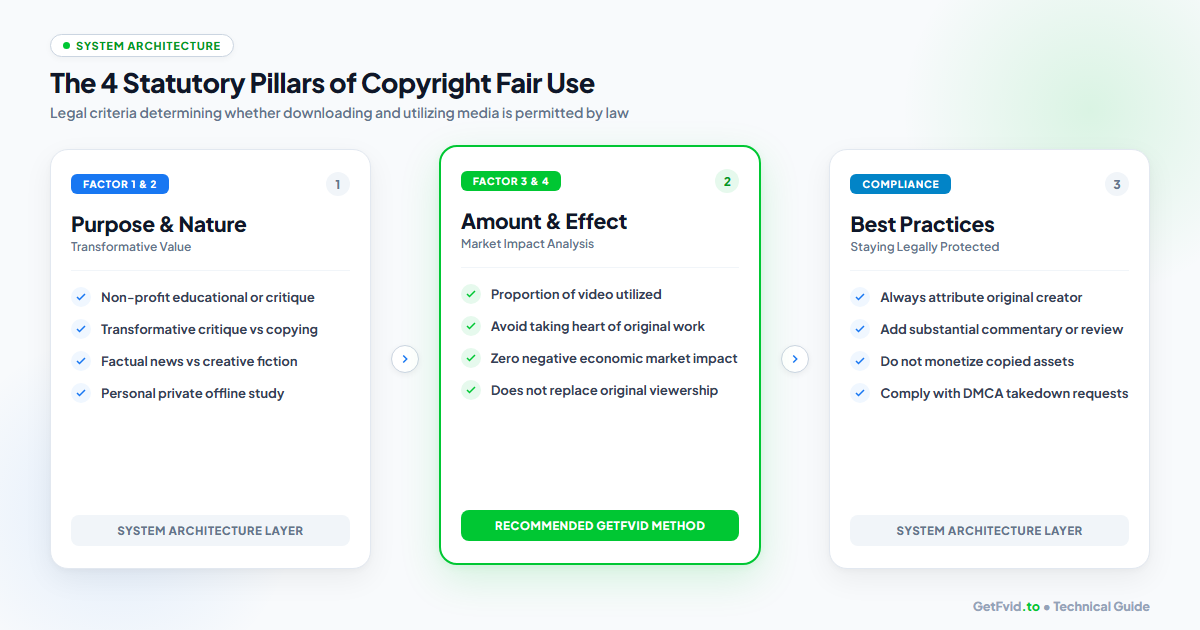
Factor 1: The Purpose and Character of the Use
- Non-Profit / Educational vs Commercial: If you save a video for private personal study, non-profit academic research, parody, news reporting, or critical commentary, courts weigh this heavily in favor of Fair Use.
- The Transformative Test: Does your use add something new, with a further purpose or different character, altering the original video with new expression, meaning, or message? In Campbell v. Acuff-Rose Music, the Supreme Court established that transformative works lie at the heart of Fair Use. Simply re-posting someone else’s viral Reel to TikTok is not transformative; adding critical commentary, educational critique, or historical context is.
Factor 2: The Nature of the Copyrighted Work
- Factual, informational, and news broadcasts receive narrower copyright protection than highly creative, fictional cinematic motion pictures or scripted comedy skits.
- Saving a public press conference, breaking news clip, or technical software tutorial is more readily defensible under Fair Use than downloading a proprietary creative short film.
Factor 3: The Amount and Substantiality of the Portion Used
- Using a brief 5-to-10-second snippet of a 15-minute video to illustrate a specific educational point is vastly more defensible than copying the entire video.
- Furthermore, courts examine whether you took the "heart of the work"-the qualitative core that gives the original video its primary commercial value.
Factor 4: The Effect of the Use Upon the Potential Market
- This is often considered the most influential factor. Does your use act as a market substitute for the original video, depriving the creator of views, advertising revenue, or licensing deals?
- If a viewer watches your re-uploaded copy instead of visiting the creator's Facebook Page, you have harmed their economic market, almost certainly invalidating a Fair Use defense.
What Is Permitted vs What Is Infringement?
To avoid legal ambiguity, examine this clear compliance breakdown:
| Activity / Action | Legal Status | Legal Justification & Precedent |
|---|---|---|
| Personal Offline Viewing | LEGAL | Time-shifting & space-shifting (Sony Corp. v. Universal City Studios) |
| Backing Up Your Own Content | LEGAL | You hold exclusive copyright ownership of your creative masters |
| Academic / Classroom Study | LEGAL | Explicit statutory exception under 17 U.S.C. § 107 |
| Fair Use Commentary / Critique | LEGAL | Transformative critique in video essays or journalistic reporting |
| Re-uploading for Ad Monetization | ILLEGAL | Copyright Infringement & unjust enrichment |
| Re-distributing Private Group IP | ILLEGAL | Breach of contract, copyright infringement & trade secret violations |
| Removing Creator Watermarks to Claim Ownership | ILLEGAL | Violation of DMCA § 1202 (Integrity of Copyright Management Information) |
The Legal Landmark: Time-Shifting & Space-Shifting Precedent
The legal justification for personal offline video recording was established in the landmark 1984 U.S. Supreme Court decision Sony Corp. of America v. Universal City Studios, Inc. (widely known as the Betamax Case).
- Universal Studios sued Sony, claiming that manufacturing Betamax video tape recorders enabled widespread copyright infringement by allowing consumers to record television broadcasts.
- The Supreme Court ruled in favor of Sony, establishing two foundational principles that govern the internet today:
- Time-Shifting: Recording a publicly broadcast program to watch at a later, more convenient time is legitimate Fair Use.
- Substantial Non-Infringing Uses: A technology or tool (like a VCR, web browser, or video downloader) cannot be outlawed simply because some users might use it unlawfully, as long as the tool is capable of substantial, commercially significant non-infringing uses (such as personal archiving, educational study, or backing up one's own footage).
When you use GetFvid to save a public Facebook video to watch on an airplane without internet access, you are engaging in lawful, protected digital time-shifting and space-shifting.
Meta's Terms of Service vs Intellectual Property Law
A common point of confusion is the distinction between the Law and a company's private Terms of Service (ToS):
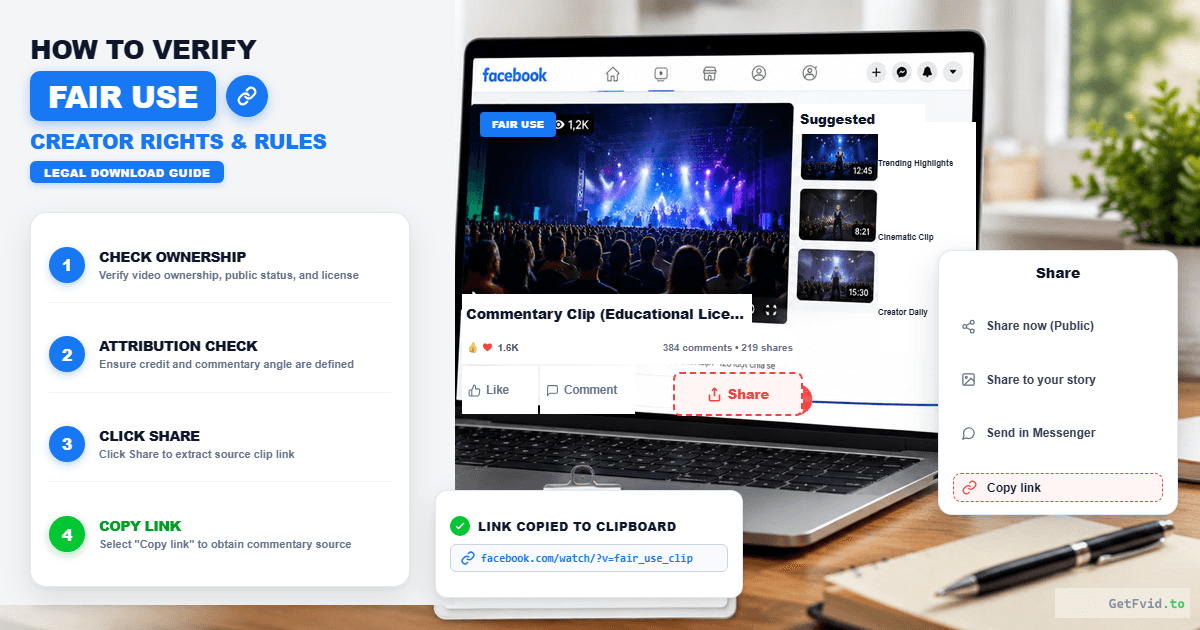
- Meta's Terms of Service: Meta’s user agreement contains clauses prohibiting automated scraping or unauthorized harvesting of platform data. These terms are private contractual agreements between Meta and registered account holders.
- Breach of Contract vs Criminal Infringement: Violating a platform’s Terms of Service by using a web utility does not automatically constitute copyright infringement or criminal conduct. As established in hiQ Labs v. LinkedIn (9th Cir. 2019), accessing publicly available web data does not violate the Computer Fraud and Abuse Act (CFAA).
- Your Content Ownership: Under Meta’s Terms, when you upload a video, you retain full copyright ownership of your intellectual property. You merely grant Meta a non-exclusive, royalty-free license to host and distribute your content. Therefore, downloading and backing up your own videos using tools like GetFvid Facebook Bulk Downloader is your fundamental legal right as the copyright owner. Read our guide: How Creators Can Back Up Their Entire Facebook Video Library.
Creator Best Practices: How to Responsibly Use Downloaded Footage
If you are a video editor, journalist, or creator incorporating third-party Facebook clips into your content, follow these strict legal compliance protocols:
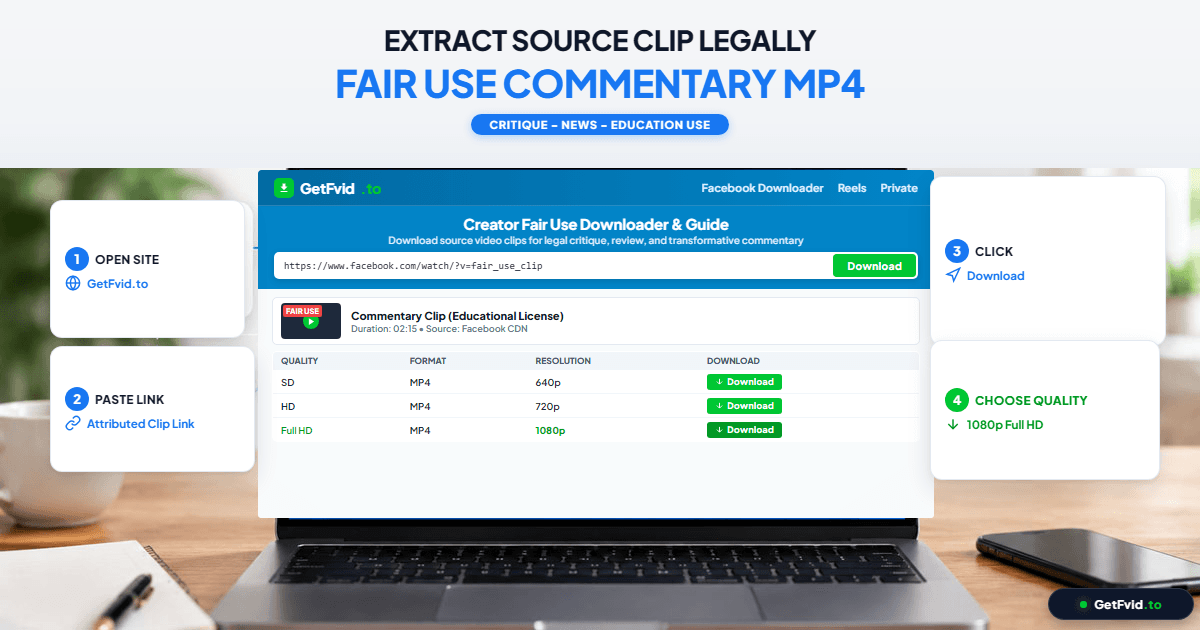
- Always Attribute the Original Creator: Clearly display the creator’s name, handle, or Facebook Page name on-screen when referencing their footage. While attribution alone does not protect against infringement, courts view attribution as evidence of good faith under Factor 1.
- Add Substantial Commentary or Reaction: Never post raw clips in isolation. Weave the footage into an analytical narrative, critique, or documentary breakdown where your added voiceover and analysis form the primary substance of the work.
- Use Only What Is Necessary: If a 10-second clip illustrates your thesis, do not include 45 seconds of footage. Keep excerpts concise and proportionate.
- Respond Immediately to DMCA Notices: If a copyright owner contacts you requesting removal of their material, comply promptly and professionally. Under the Digital Millennium Copyright Act (DMCA), platforms and creators maintain "Safe Harbor" protections by expeditiously removing contested material upon formal notice.
Private Group Content: Additional Legal Considerations
Downloading content from Closed or Secret Facebook Groups carries heightened legal sensitivity:
- Implied Confidentiality: Content shared inside paid mastermind groups, private corporate communities, or closed coaching cohorts often carries explicit or implied non-disclosure terms.
- Trade Secret & Contract Violations: Downloading and leaking proprietary course modules or confidential business discussions to external public forums can expose you to civil lawsuits for breach of contract, tortious interference, and trade secret misappropriation.
- Safe Personal Archiving: If you paid for an educational workshop hosted in a private group and download the videos purely for your own personal offline study using GetFvid Facebook Private Downloader, this generally remains legally sound. However, sharing those files with non-members is strictly prohibited. Learn more in our Private Group Video Download Guide.
Frequently Asked Questions (FAQ)
Can I be sued or fined for downloading a Facebook video to my computer?
No individual consumer has ever been successfully sued or prosecuted simply for downloading a publicly available social media video for personal, non-commercial offline study. Legal liability arises exclusively when an individual redistributes, broadcasts, resells, or commercially exploits copyrighted media without authorization.
What should I do if someone downloaded my Facebook Reel and reposted it without permission?
If an unauthorized third party copied your video and posted it to Facebook, Instagram, TikTok, or YouTube, you have the legal right to submit a formal DMCA Takedown Notice to the hosting platform. Meta, ByteDance, and Google are legally required under 17 U.S.C. § 512 to remove the infringing content upon receiving a valid notification.
Does GetFvid host or distribute copyrighted video files?
No. GetFvid is a technical client-side utility, not a media host. We do not store, host, mirror, or index video files on our servers. All video streams originate directly from Meta’s public Content Delivery Network (CDN) servers. Our service operates in full compliance with international DMCA intermediary regulations; review our complete Terms of Service and Privacy Policy.
Can I download Creative Commons or Public Domain Facebook videos?
Yes! Videos designated under Creative Commons (such as CC-BY) or works produced by government entities in the public domain are legally free to download, study, and reuse in accordance with their respective licensing parameters.
How do I legally extract background music or speech from Facebook videos?
If you are extracting audio for personal offline listening, speech transcription, or educational sampling, use our dedicated audio converter: How to Extract Audio & MP3 from Facebook Videos. Remember that commercial music remains protected by intellectual property laws.
Download Facebook Videos in High Quality Now
Paste your Facebook video link into GetFvid to download to your device in 1080p Full HD, 100% free.